For People with Dysarthria
Your message stays yours, just easier to understand
Helping you be understood, not just heard
Speak into your microphone. DysVoxa Neurospeech Platform helps make speech clearer and sends the improved output to your call
app through a virtual microphone.
Important notice
- This helper is not a cure and is not framed as a miracle outcome.
- It currently works for the founder at the time of writing, but individual results can differ.
-
Founder context: spinocerebellar ataxia (SCA), diagnosed at age 45, with partial cerebellar atrophy and
light-to-moderate dysarthria.
- This tool is intended to support communication for people with dysarthria and other speech impairments.
How daily use works
- Run a quick enrollment to capture your speech profile.
- Open your call app and select the DysVoxa virtual microphone.
- Speak naturally. The system handles correction and output in real time.
Why users choose it
- Built for non-standard articulation patterns in dysarthria.
- Identity-preserving correction strategy.
- Works with common meeting tools used by family, work, and care teams.
Privacy choices
Local-first mode
Keep processing on your machine whenever possible.
Cloud fallback
Optional remote processing for broader model options.
How DysVoxa works in real time
The system listens to what you say, analyzes it, corrects it intelligently, and sends the corrected output to your call platform — all within seconds. The result: conversation flows naturally, with no awkward pauses.
Speech recognition
Your voice is transcribed quickly and accurately, even with dysarthric patterns.
Correction
An AI reviews the transcript and makes only the edits needed for clarity—nothing more.
Voice synthesis
The corrected text is read aloud in a natural, clear voice that sounds professional.
Real-time delivery
The other person on the call hears clear speech without knowing DysVoxa is working behind the scenes.
Your voice identity matters
DysVoxa was built on one core belief: your voice stays your voice. That means the system won't rewrite your words or phrases just to make them sound "more standard." Instead, it works conservatively—making only the minimal edits needed to improve clarity while preserving your personal communication style, phrasing, and intent.
- Short phrases (up to 6 words) receive minimal correction—we only touch what urgently needs fixing for clarity.
- Medium phrases (6–12 words) may get light edits on individual words if needed, but the structure stays yours.
- Longer phrases (12+ words) often pass through nearly unchanged to avoid any risk of semantic drift.
- Your personal rhythm, pitch patterns, and naturally spoken words are fully preserved.
Psychological support: Building confidence and comfort
People with dysarthria often experience communication anxiety—worry about being misunderstood or feeling that conversations are taking too long. DysVoxa is designed to ease these concerns in several ways:
-
No wasted time. With real-time correction, there's no need to repeat or explain—results are simply sent to the other person's device instantly. Conversations flow.
-
Gradual adjustment. In your first week, run offline (no-call) test sessions with just a few phrases to check accuracy. There's no pressure to rush into live conversations.
-
Identity preservation. If you ever feel the system made a change you didn't like, you can provide feedback—which helps both you and your SLP understand what matters most to you.
-
Practice support. Before an important call, you can run a practice session with DysVoxa offline—rehearsing and building confidence without any real-time pressure.
Important: Psychological support goes beyond the tool itself. It means being kind to yourself, taking breaks when you feel frustrated, and talking openly with your SLP or care team about what's working and what isn't. The goal is communication that feels sustainable and empowering, not one more thing that adds stress.
Practical speech and breathing exercises at home
Safety and general tips
- Always check with an SLT or doctor first, especially after stroke, TBI, or neuromuscular disease.
- Do short, frequent sessions (5–10 minutes, 2–3 times a day) and stop if there is pain, dizziness, or strong fatigue.
1. Breathing and support
Goal: stronger, more controlled airflow for speech.
-
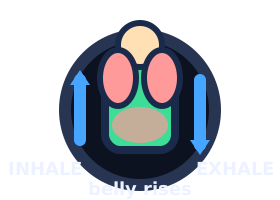
Diaphragmatic breathing
- Sit upright, one hand on chest, one on belly.
- Inhale through nose so the belly hand rises, chest hand stays mostly still; exhale slowly through mouth.
- Practice 10 slow breaths, 2–3 sets.
-
Breath + sound
- Inhale with belly out, then say "sss" or "shhh" on the exhale for as long and as steadily as possible.
- Progress to "aaa", then to short words like "hello", then short phrases on one breath.
2. Loudness (phonation)
Goal: stronger, more consistent voice.
-
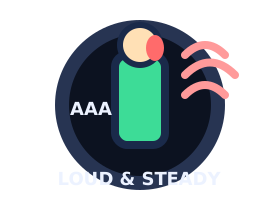
Sustained vowel
- Take a deep breath and say "aaa" at a comfortable, loud level.
- Aim for steady loudness and pitch; hold 5–10 seconds, rest, repeat 5–10 times.
-
Loud phrases
- Read or repeat short functional phrases (e.g., "Good morning", "My name is…") using an intentional "big, strong voice."
- Record on a phone so you can compare quiet vs loud attempts.
3. Articulation (lips, tongue, jaw in speech)
Goal: clearer articulation and better intelligibility.
Evidence is mixed for non-speech strengthening alone, but task-oriented speech practice with clear over-articulation can help intelligibility.
-
Over-articulation drill
- Patients reads or repeats word lists, exaggerating mouth movements: "papa, baby, tomato, banana…".
- Use slow rate and strong consonants; practice 5–10 minutes with rest breaks.
-
Minimal pairs / contrast practice
- Use pairs like "tap–cap, bat–pat, tea–key" and have the patient produce both words clearly.
- Give mirror or video feedback so they see tongue/lip placement.
4. Simple oromotor range-of-motion (use with caution)
Note: These are sometimes used as part of a broader program; the direct impact on speech is debated, so they should not replace speech-based tasks.
-
Lip movements
- Pucker lips as if to whistle, then spread into a wide smile; alternate 10–15 times.
- Press lips together tightly for 3 seconds, then relax; repeat 10 times.
-
Tongue movements
- Stick tongue out straight, then pull back; move tongue side-to-side to each corner of the mouth, then up toward nose and down toward chin; 5–10 reps each.
- Press tongue to the inside of each cheek and hold 3 seconds.
5. Rate control / pacing
Goal: slower, more controlled rate is one of the most supported strategies for many dysarthria types.
-
Pacing board
- Draw 4–5 big dots in a row on card.
- Patient touches one dot per syllable while reading or repeating phrases, e.g., "I / want / some / cof-fee."
-
Hand tapping
- Patient taps the table once per syllable as they speak, focusing on clear consonants at each tap.
6. Prosody and naturalness
Goal: less monotone, more natural stress patterns.
-
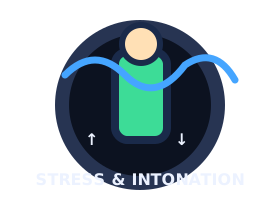
Stress practice
- Have the patient say the same sentence changing the stressed word: "I wanted the blue pen" vs "I wanted the blue pen".
- Use arrows or bold text on printed sentences to mark the stressed word.
-
Intonation lines
- Draw rising/falling lines above sentences on paper; patient follows the line with their voice.
- Practice with questions (rising) and statements (falling).
Recommended frequency: 5–10 minutes, 2–3 times daily, with rest breaks.
Reference resources
Quick FAQ
Do I need a special app on the other side?
No. Recipients can stay on Zoom, Teams, Meet, or standard call tools.
Which dysarthria types are supported?
Ataxic, flaccid, hyperkinetic, hypokinetic, mixed, and spastic profiles.
Will it replace my voice?
No. The goal is intelligibility support while preserving voice identity.
Can I use it with my therapist?
Yes. The setup is designed for iterative tuning with SLP support.
Working with your SLP (speech-language pathologist)
DysVoxa is not meant to replace speech therapy or medical care. Instead, it's designed to complement traditional rehabilitation and provide real-time communication support alongside clinical treatment.
-
Tracking progress: You and your SLP can work together to measure improvements over time using Word Error Rate (WER) or intelligibility scales (MOS). It's a shared way to see what's working and adjust goals.
-
Tuning to your diagnosis: DysVoxa can be configured differently for flaccid, ataxic, spastic, and other dysarthria types. Your clinician can help set the optimal correction aggressiveness for your profile.
-
Blending with therapy: You can use DysVoxa's practice exercises (breathing, articulation, pacing) alongside formal therapy sessions to increase your total practice time and reinforce skills.
-
Iterative adjustment: As you progress, your SLP can help fine-tune DysVoxa settings and advise on when to shift focus to different rehabilitation goals.
Important note: Dysarthria is a neurological condition. After stroke, brain injury, or other neurological events, some people experience natural recovery over weeks or months due to brain neuroplasticity. DysVoxa helps you maximize communication during that recovery window and provides real-time support—but it works best as part of a comprehensive treatment plan with your care team.
Patient support contact
Send your setup question, accessibility needs, or early access request.
Practical dysarthria resource guide
This NHS resource pack provides comprehensive guidance on managing dysarthria in daily life. Download or view below.